

History and Development
When the U. S. Army Air Corps issued specification No. X-609 in March 1937, Robert J. Woods, chief engineer at the Bell Aircraft Corporation, was ready. Two months later, Woods proposed the Bell Model 4 to meet this specification for a highly-maneuverable fighter airplane with good visibility, heavy firepower, exceptional takeoff and landing qualities, and better ground-handling than existing types. The Air Corps was impressed enough to award Bell a contract for a single prototype, designated XP-39, on October 7, 1937, and the P-39 was born.
Woods designed the P-39 around one primary component--the 37mm cannon. Considerable trial and error was required to avoid sacrificing the important airframe and engine requirements, such as speed and maneuverability, to the cannon's weight, size, and recoil characteristics. One arrangement had the cockpit located behind both the engine and the cannon but poor visibility ruled out this version. The final scheme mounted the engine amidships behind the pilot and cannon. A long drive shaft connected the engine and propeller gearbox. The cannon was located between the pilot and the propeller so that the gun could fire through the propeller hub. Woods envisioned the large space under the cannon as a place to store the retractable nosewheel and the Airacobra became the first Air Corps single-engine airplane with a tricycle landing gear.
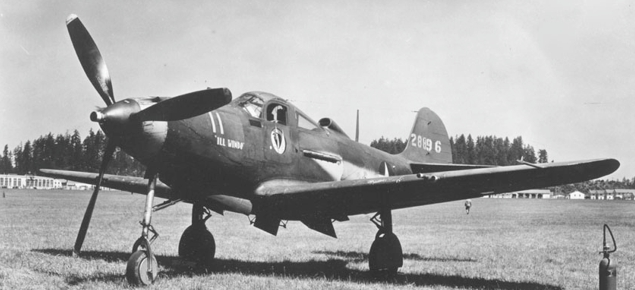
A P-39N Airacobra belonging to the 353rd Fighter Squadron at Santa Rosa Army Air Field, California.
Bell built the XP-39, U. S. Army Air Corps serial number 38-326, at its plant in Buffalo, New York. When the new fighter made its first flight on April 6, 1939, a turbo-supercharged Allison V-1710-17 engine powered the aircraft to a speed of nearly 627.9 kph (390 mph) at 6,080 m (20,000 ft). Two months after the first flight, the National Advisory Committee on Aeronautics (NACA) at Langley, Virginia, studied the XP-39 and recommended a list of modifications. It was primarily interested in streamlining to reduce drag but the modifications they ordered increased the loaded weight by 114 kg (250 lb) to 2,903 kg (6,450 lb). Even more damning, NACA advised the Air Corps to remove the turbo-supercharger, and it apparently agreed, believing that an engine with a geared supercharger was close at hand. However, Allison was years away from fielding such a powerplant and when it did, newer and more advanced airframes became the logical recipients. Without this vital component, the P-39 became unsuitable for combat above about 6,080 m (20,000 ft).
With war clouds gathering, the Air Corps contracted with Bell for eighty production airplanes designated the P-39C (twenty airplanes) and the P-39D (sixty airplanes). To supplement the cannon, Bell armed the P-39C with two .50 and two .30 caliber machine guns mounted in the upper nose cowling to fire through the propeller. The company relocated the .30 caliber gun battery to the wings and doubled their number on the P-39D. Foreign air forces, debilitated by years of fiscal neglect, frantically bought up the first Airacorbras. In 1940, the French and the British each signed contracts for hundreds of export Airacobras. The order came too late for the French and the British found nothing to like in the P-39 so many of these airplanes were redirected to the Air Corps and redesignated as P-400s. The British Government sent most its P-39s to the Soviet Union. The Army Air Corps had absorbed 179 Airacobras destined for England and most of these fighters went into action in the Pacific Theater with the 8th Pursuit Group at Port Moresby, New Guinea, in April 1942. For the next year-and-a-half, the best fighter aircaft the United States could field were P-39s and Curtiss P-40s.
Sed at odio ut arcu fringilla dictum eu eu nisl. Donec rutrum erat non arcu gravida porttitor. Nunc et magna nisi.Aliquam at erat in purus aliquet mollis. Fusce elementum velit vel dolor iaculis egestas. Maecenas ut nulla quis eros scelerisque posuere vel vitae nibh scelerisque lorem mattis.
Sed at odio ut arcu fringilla dictum eu eu nisl. Donec rutrum erat non arcu gravida porttitor. Nunc et magna nisi.Aliquam at erat in purus aliquet mollis. Fusce elementum velit vel dolor iaculis egestas. Maecenas ut nulla quis eros scelerisque posuere vel vitae nibh scelerisque lorem mattis.
Sed at odio ut arcu fringilla dictum eu eu nisl. Donec rutrum erat non arcu gravida porttitor. Nunc et magna nisi.Aliquam at erat in purus aliquet mollis. Fusce elementum velit vel dolor iaculis egestas. Maecenas ut nulla quis eros scelerisque posuere vel vitae nibh scelerisque lorem mattis.
Sed at odio ut arcu fringilla dictum eu eu nisl. Donec rutrum erat non arcu gravida porttitor. Nunc et magna nisi.Aliquam at erat in purus aliquet mollis. Fusce elementum velit vel dolor aculis egestas. Maecenas ut nulla quis eros scelerisque posuere vel vitae nibh scelerisque lorem mattis.
Sed at odio ut arcu fringilla dictum eu eu nisl. Donec rutrum erat non arcu gravida porttitor. Nunc et magna nisi.Aliquam at erat in purus aliquet mollis. Fusce elementum velit vel dolor aculis egestas. Maecenas ut nulla quis eros scelerisque posuere vel vitae nibh scelerisque lorem mattis.
Sed at odio ut arcu fringilla dictum eu eu nisl. Donec rutrum erat non arcu gravida porttitor. Nunc et magna nisi.Aliquam at erat in purus aliquet mollis. Fusce elementum velit vel dolor aculis egestas. Maecenas ut nulla quis eros scelerisque posuere vel vitae nibh scelerisque lorem mattis.
Technical Specifications
Sed at odio ut arcu fringilla dictum eu eu nisl. Donec rutrum erat non arcu gravida porttitor. Nunc et magna nisi.Aliquam at erat in purus aliquet mollis. Fusce elementum velit vel dolor aculis egestas. Maecenas ut nulla quis eros scelerisque posuere vel vitae nibh scelerisque lorem mattis.
Sed at odio ut arcu fringilla dictum eu eu nisl. Donec rutrum erat non arcu gravida porttitor. Nunc et magna nisi.Aliquam at erat in purus aliquet mollis. Fusce elementum velit vel dolor aculis egestas. Maecenas ut nulla quis eros scelerisque posuere vel vitae nibh scelerisque lorem mattis.
XP-39
Prototype Model Designation sans armament.
YP-39
Prototype Preproduction Models of which 13 were produced; improved XP-39 model.
YP-39A
Preproduction XP-39 Model fitted with an Allison V-1710 engine sans turbocharger; single high-altitude test frame conversion model.
YP-39B
Based on the XP-39; fitted with new engine sans turbocharger; single unit produced.
P-45
Initial Production Designation offered by the US Army to signify major changes to model P-39C; later dropped in favor of P-39 designation.
P-39C
Initial Production Models; 80 examples produced; 60 P-39C models became P-39D types.
P-39D
Production Model fitted with self-sealing fuel tanks and increased heavier armament (addition of 2 x 12.7mm machine guns in upper forward fuselage); Allison V-1710-35 water-cooled engine generating 1,150hp; conversion models from P-39C series.
P-39D-1
Lend-Lease Model with Hispano-brand 20mm cannon; improved P-39D models with self-sealing fuel tanks; 863 examples produced.
P-39D-2
Lend-Lease Model with Allison V-1710-63 (E6) powerplant; improved P-39D-1 model series; 158 on order; 1 conversion model from P-39D-1.
XP-39E
3 examples produced with new powerplant of Continental I-1430-1 at 2,100hp; becoming the XP-63 "Kingcobra" prototype.
P-39E
Improved P-39D-1 model; though 4,000 were on order none of this type were produced.
P-39F-1
Based on the P-39D model but fitted with Aeroproducts-produced constant-speed propeller system.
P-39F-2
P-39F models modified for photo reconnaissance duties; 2 converted as such.
P-39G
1,800 were ordered though eventually becoming the K, L, M and N models in the series.
P-39J
Modified P-39D-1 model series with new engine and auto boost feature; 25 examples produced.
P-39K
Fitted with V-1710-63 powerplant and Curtiss-produced propeller system; based on P-39F model series; 210 examples produced.
P-39L
Modified P-39K series with Curtiss brand propellerand rocket rails installation; 250 examples produced.
P-39M
Fitted with V-1710-83 powerplant capable of 1,200hp and a larger propeller system; gearing changed; 240 examples produced.
P-39N
Improved P-39M series; fitted with V-1710-85 powerplant; decreased armor protection and fuel for increased weight and performance.
P-39Q
Improved P-39N series; 1 x 37mm cannon and 4 x 12.7mm machine guns - two held in underwing gunpods and synchronized to fire through the propeller.
Bell Model 14
French Order Model Designation; never delivered.
Airacobra Mk I
British Delivery Models.
P-400 Airacobra I
Royal Air Force Designation.
TP-39F
Dual-Seat Trainer Model.
RP-39Q
Limit Production Dual-Seat Trainer Model.
F2L
US Navy Target Drone Designation.
XFL-1 "Airabonita"
Single Example Prototype Model for evaluation by US Navy; traditional landing gear array instead of tricycle type.
A-7
Proposed Radio-Controlled Drone.
TDL
US Navy Radio-Controlled Target Drone.
P-39D
Type: Single-seat interceptor fighter/fighter-bomber
Powerplant: Sed at odio ut arcu fringilla dictum eu eu nisl. Donec rutrum erat non arcu gravida porttitor.
Wing Span: Sed at odio ut arcu fringilla dictum eu eu nisl. Donec rutrum erat non arcu gravida porttitor.
Length: Sed at odio ut arcu fringilla dictum eu eu nisl. Donec rutrum erat non arcu gravida porttitor.
Height: Sed at odio ut arcu fringilla dictum eu eu nisl. Donec rutrum erat non arcu gravida porttitor.
Wing Area: Sed at odio ut arcu fringilla dictum eu eu nisl. Donec rutrum erat non arcu gravida porttitor.
Empty Weight: Sed at odio ut arcu fringilla dictum eu eu nisl. Donec rutrum erat non arcu gravida porttitor.
Maximum T/O Weight: Sed at odio ut arcu fringilla dictum eu eu nisl. Donec rutrum erat non arcu gravida porttitor.
Maximum Level Speed: Sed at odio ut arcu fringilla dictum eu eu nisl. Donec rutrum erat non arcu gravida porttitor.
Initial Climb: Sed at odio ut arcu fringilla dictum eu eu nisl. Donec rutrum erat non arcu gravida porttitor.
Service Ceiling: Sed at odio ut arcu fringilla dictum eu eu nisl. Donec rutrum erat non arcu gravida porttitor.
Range: Sed at odio ut arcu fringilla dictum eu eu nisl. Donec rutrum erat non arcu gravida porttitor.
Armament: Sed at odio ut arcu fringilla dictum eu eu nisl. Donec rutrum erat non arcu gravida porttitor.